
I was in a meeting of professionals concerning a young person a while back.
This boy, whom we’ll call Sam, had sodded off school, started hanging with the wrong crowd, doing all the wrong things, experimenting with alcohol and petty crime – standard issue stuff for the off-the-rails teenager.
In his teens, Sam goes off the rails, but prior, Sam was a well-behaved child, shy and sweet-natured by all accounts.
The question that naturally arises is always, “Why?”
Attention turns toward the family, and we raise an eyebrow in quizzical concern.
In assessing other potential impactors, there was a very informative story shared about Sam from when he was still attending school.
As I heard this story I was instantly reminded of a book I read whilst dog-sitting at a South African family’s house, which I would like to recount before I tell you Sam’s school story.
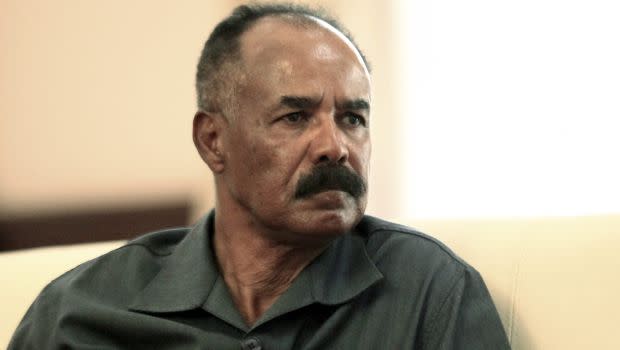
Afwerki
Eritrea is a diddy totalitarian nightmare sat in the sweep of the Horn of Africa.
The ‘North Korea of Africa’ is run by a secretive and sadistic regime, at the head of which stands the secretive and sadistic dictator, Isaias Afwerki.
Afwerki is a charismatic national hero turned despotic villain. A few still consider him the former, the rest of planet earth the latter.
The question that not-so-naturally arises when it comes to adults is, “Why?”
Once upon a time, Afwerki was an awkward, quiet and powerless teenager, and Eritrea a country occupied by western and Ethiopian forces.
“Tongue-tied and shy,” writes Paul Kenyon in Dictatorland: The Men Who Stole Africa, “his adoption by the inner circle [of Eritrean revolutionary fighters] came quite suddenly, and had little to do with his political beliefs.”
So what catalysed Afwerki’s transition from shy student to violent revoluntionary?
Afwerki had an American teacher for his physics lessons, who liked to announce the marks of his students in front of the whole class.
“Isaias Afwerki rarely performed well in homework, but on this occasion he was awarded a particularly poor mark. When it was read out to the front of the class, he rose from his desk, walked quietly to the front and slapped the teacher in the face. Such a defiant, anarchic recruit is exactly what the young activists required. He joined the others…” and the rest is history.
Rising through the ranks of the revolutionaries, Afwerki spearheaded the long war for Eritrean independence and has kept the country under hammerlock since.
Sam
Sam asked to be excused to use the restroom.
His teacher put it to a classroom vote, singling him out and embarrassing him in front of his peers.
In another cruel twist, the class voted against Sam’s right to relieve himself.
This at an age when all that matters to young people is the esteem in which their peers hold them.
Sam’s behaviour took a dark and sometimes sinister seeming turn.
School attendance dropped precipitously.
Things changed that day.
We all hope it is not a case of, ‘and the rest is history’.
Thoughts
Being a fierce proponent of personal responsibility, I don’t want to say Afwerki is a murderous multi-decadal dictator and Sam is off the rails because of their teacher facilitated public humiliations.
And yet, despite the yawning gap of time and place and culture and all of the rest of it, there is a crystal-clear cross-culturally valid lesson to learn from these stories.
The potential impact adults in positions of power can have on young people at this developmentally critical age, for better or worse, can be exponential.
In the case of Afwerki’s physics teacher, it impacted the destiny of a whole nation.
In the case of many young people I work with, adults have abused or forsaken their responsibility to pay heed to this truth: how you treat young people, what you say and do to to them, or what you fail to say and do, may irrevocably impact their life trajectory.
Do let me know what you think.
And Merry Monday, friends.
P.S. Be prepared for a much chirpier ditty next time: one of these very young people has told me a story that I’m going to share with you, it’s amazing and adorable.
 The Works and Chirps of a Guernseyman